A clipboard for marking off your routine language learning tasks

Routine-building: productivity tricks to turbocharge your language learning

Good intentions are cheap. A new learning project can fill anyone with enthusiasm and optimism. But without one extra thing, good intentions quickly sink. That thing is routine.

Life has a habit of getting busy, and people get distracted. Days run into weeks, and before you know it, you haven’t done any French / German / Spanish since last month. It happens to the best of us, even those who consider themselves fairly well organised. That’s why creating a scaffold of systematised routine around your learning goals can help keep you on track.

Keeping up momentum

Ideally, you should be setting yourself daily learning goals in order to keep up momentum with your studies. This might sound like a hefty commitment, but needn’t be more than a few minutes a day if you’re fitting learning around a busy life; you’ll benefit from the regularity of it (and not get bored by mammoth learning sessions either).

But it’s sticking to this daily routine that can be problematic. It’s too easy to forget, to get sidetracked, or make promises to catch up that you never honour. Fortunately, there are several great tools for tackling these problems, and none of them need cost a penny.

Never forget: Wunderlist

We’re lucky that today, apps can pick up the slack for our sometimes overtaxed brains. One app that I entrust the job of reminders to is the wonderful Wunderlist.

The magic of to-do apps like Wunderlist is in the facility to set automatically repeating tasks with reminders. For instance, I aim to run through my Anki Flashcard vocabulary every day (it just takes 10 minutes or so). In Wunderlist, I add a to-do for that, setting it to repeat daily, with a reminder in the evening. I set up similar to-dos for my weekly tasks, like listening to a podcast and taking notes, or reading news headlines in the target language.

Creating a regular language routine with Wunderlist

Creating a regular language routine with Wunderlist

Why is Wunderlist better than the plain old to-do app that comes with your phone OS? Well, it can do some very fancy things very well, if you want to stretch your learning. Learning a language with someone else? You can have shared to-do lists, and to-do list folders. Learning several languages? You can have multiple lists, and list folder to help you organise. You can even use it as a basic project manager, assigning subtasks to your more general to-dos (perhaps breaking ‘Learn French Vocabulary’ into ‘5 irregular verbs’, ‘5 phrases from Book X’ and so on).

It’s also cross-device, so you can manage your tasks on any device with an Internet connection. Perfect for when I’ve just done my words on the bus, and want the satisfaction of marking it as ‘done’ immediately!

Moreover, as a sweetener, you can add emoticons like flags to your to-dos quite easily on a device (see my screenshot above). It’s the little things! 😉

Tick-box challenge: Evernote

I’ve mentioned the excellent 12 Week Year plan in a previous post. This productivity method, rooted in the business world, outlines short-term goal-planning techniques as a means to boost efficiency. However, it can work brilliantly for language learners.

The approach uses a weekly list of ‘tactics’ that you need to complete in order to stay on track. Ticking off your daily / weekly tactics as you complete them can give you a real sense of achievement, and you find yourself motivated to keep your completion rate high, and beat your previous form. It turns to-do lists into a kind of personal challenge – learning, instantly gamified!

I find Evernote – available in its basic version for free – is perfect for making these weekly plans. You can add dynamic tick boxes next to your list items in the app, which makes tracking your progress really easy. Like Wunderlist, it’s available on many devices and platforms, too.

To give your learning an Evernote boost, first decide on the things you want to do each week in order to progress. Then add them to a note in the app, including a tick box next to each one. At the end of each week, tot up the percentage of boxes you ticked, and make a note of your score before writing a planning note for the following week. Brian Moran, writer of The 12 Week Year, suggests 85% as a good completion rate to aim for.

Ideas for entries might include:

  1. Add 20 words to Anki Flashcards every week (one tick box)
  2. Drill with Anki Flashcards every day (seven tick boxes)
  3. Read 3 full-length articles in the target language each week (three tick boxes)
  4. Have two half-hour language exchange conversations with a partner (see iTalki for more about finding language exchange partners)
Example of an Evernote productivity list to help create a routine for your language learning

Creating language routines with Evernote

Routine browser links: Chrome

Setting yourself a reading goal is a great challenge for language learners. There is a ton of material published across all sorts of subjects online, and the trick is to find stories that spark your interest.

But how can you keep your list of regular reading organised and accessible? Well, browser bookmarks are a start. But if you’re anything like me, you’ll enthusiastically bookmark a page, never to dig into your bookmark list again (let alone every day, which is my goal).

There is another way to bookmark, though. It’s called the bookmarks bar in Chrome, and many other browsers have a similar feature. Instead of tucking your most visited links away in a menu or folder, it puts them right at the top of the browser window, always visible. If you find a really useful site, you can drag the address from the URL field to the bookmark bar to pin it there.

So how to take advantage of this? I have a couple of news sites that I try to check every day to practise target language reading. All of them are my first bookmarks bar links, so the moment I open the browser, they’re there, reminding me that I need to check them. No forgetting, no hiding, and a bit of guilt if I ignore them. It becomes almost second nature to click them as soon as you fire up the browser – the ultimate habit-former. Magic! You can only fit a few in your bar, so reserve it for those sites you feel you’ll get a daily benefit from.

The Chrome bookmarks bar can be an excellent way to build routine into your language learning

The Chrome bookmarks bar


Cross-pollination

Learning a language is a commitment, and commitment takes routine. I’ve come across these routine-building techniques through my work in a business environment, rather than the classroom. But I’ve become a huge fan of cross-pollinating these kinds of productivity hacks with language learning.

The greatest lesson I’ve learnt in this is not to box off your language learning, but let it be informed by, and inform in return, the rest of your life. Creating routine is a great place to start that melding process!

Which language do you choose out of 7,000 in the world?

Language choice: finding your Wonderland

With nearly 7,000 languages spoken in the world today, how do you choose which one(s) to study? It’s a question I often hear, but one I don’t really think about much. For me, language learning has always been an end in itself, first and foremost. I love dabbling, exploring, playing around with new languages.

But for someone new to the linguaphile world, it’s an understandable question. Can there be some logical approach to choosing a language to learn, all things being equal?

Number of native speakers

The most obvious practical consideration is language use; after all, language’s primary function is communcation, right? Just how much of the world will open up to you if you learn a language?

Ten of the world’s languages have over 100 million native speakers: in order, Chinese, Spanish, English, Arabic, Hindi, Bengali, Portuguese, Russian, Japanese and Lahnda (Western Panjabi). The polyglossically-minded might try to tackle all ten. This would grant you linguistic access to a staggering three-and-a-half billion of the world’s population. You could be transported to a random, populated spot of our world of 7.4 billion people, and have a nearly 50% chance of being able to speak the language!

Building bridges

However, random transportation isn’t really a thing. And a glance down that country list shows how far-flung and distantly distributed all these languages are across the map. Chances are, you don’t live next door to many of them.

Here, then, comes the just-over-the-fence / just-across-the-pond option. It’s the reason why so many British schoolchildren grow up learning French, German or Spanish. Pick a close neighbour, and learn about them – what better way to build bridges? (And boy, has there been a better time to build bridges?)

Being on the doorstep, there’s not only a ready supply of teachers and access to resources, but the chance to travel not too far to practise your skills. France is likely to be one of the first foreign countries British students set foot in. Spain is a short flight away and a hugely popular holiday destination for British families. In some parts of England, you can pick up Welsh language TV. There’s a lot to be said for learning a neighbouring language!

Then again, bridge-building does require a soupçon of warmth and goodwill towards neighbours, and this can sometimes seem in short supply.

The economy, stupid

You could be more mercenary, and decide that you’re going for the powerful countries. Cynically speaking, money is power these days, so you’ll looking at the languages of the top ten countries by GDP. That gives you English, Chinese, Japanese, German, French, Hindi (along with India’s other languages), Italian, Portuguese and Korean. Learn one of those, and you have the language skills to land a job in a country that’s doing pretty well for itself.

The trouble is, global politics changes so quickly. Devote ten years to learning English, and you might find that China has become the new superpower. Stick all your eggs in a German basket, and you might find that Poland has become the European economic powerhouse in a decade or two. Picking a language on its prospects as a world business language can seem a little like playing roulette.

Language as cultural key

Moreover, I’m not a cynic. There’s far more to life than money, and there’s even more to a country than GDP. Sometimes it’s hard to put your finger on exactly why a country or culture holds a certain fascination for you.

The reasons could be entirely romantic; ever since I was a kid, I’ve been intrigued by Nordic culture. I admit that has less to do with reality, and more to do with snow-and-ice depictions of reindeer, Norse gods and Vikings. The release of Disney’s Frozen did nothing to cure my Nordic romanticism. But realistic or not, therein lies the attraction for me, and it was the hook that got me into learning Norwegian and Icelandic.

There’s no shame in letting imagination lead your language choices. You’ll be more engaged, and greater engagement helps you to access that state of flow in which learning can (sometimes) feel effortless. If you can handle the disillusionment when your imagined wonderland turns out to be quite everyday (Norway isn’t full of Vikings, disappointingly), then you might also spark a lifelong love affair with the your target language culture.

Language as Heritage

Linked to these romantic ideas, but closer to home, we have heritage reasons for language choice. Again, motivation is likely to be high with this rationale – there’s the feeling that you can get close to your roots, your ancestors, your soul, when learning a language with regional links to your family.

Barely 50,000 people speak Scottish Gaelic as a first language today, but all the economics and utility in the world won’t take the shine off learning it if you know your forebears may have used it.  And sometimes, the passion can lead to rebirth, as seen in the re-blossoming of Welsh, and the beginning of a Cornish language revival.

Meta-language

Still can’t decide? Well, maybe you don’t have to. You could take a broader brush, and study language in general.

A good way to get a general feel for a lot of languages is to study their reconstructed development from proto-language. There is something awe-inspiring about reading how our ancestors (probably) spoke. You can get a sense of the depth of history when you see how a word you use every day developed from a root that emerged thousands of years ago.

There are some excellent books on Indo-European, for example, which go into great detail about vocabulary and grammar:

Others, like Routledge’s The Indo-European Languages, or the even more specific The Germanic Languages, give snapshots of the modern members of the language family, while highlighting their relationships to each other. Either way, you’ll get a fascinating glimpse into how language, and culture, spread and diversify. Seeing links between languages can also help strengthen your understanding of how a given, single one works.

As for me…

At school I learnt French and German, then German and Spanish at university (bridge-building and economics, you might think). But then – I must admit – practical, dry, real-world reasoning went out of the window. Language is the whole point now – there’s doesn’t need to be a reason beyond because I like it. I’m just drawn to particular countries and cultures, and this is what guides my choices.

Often, it’s down to which places are cheapest to travel to – Polish is definitely attractive at the moment! Other times, you’ll be bewitched, and keep going back despite the expense (thanks, Norway and Iceland). I love travelling, being abroad, trying to communicate and making friends in a foreign language. And I’ll grab every opportunity I can to do that!

Find your Norway / Iceland / Poland / Wonderland and pursue it. All the practical reasons in the world won’t trump passion.

Sites like Swagbucks can really help spare your wallet by offering rewards you can turn into language learning resources.

Swagbucks for linguists: premium learning that spares your wallet

Language learning can be a pricey business. Apps, books, subscriptions – they all add up. Enter Swagbucks, which is great for turning clicks into learning resources!

I’ve been using the Swagbucks reward site since November, when I found out that it offers iTunes credit as rewards. I’d put off buying an expensive language learning app, AnkiMobile Flashcards, due to the cost. But if I could earn vouchers to buy the app rather than use my own money, it wouldn’t hit my pocket so hard!

It took me a few weeks of occasional surveys and clicks to reach the £20 iTunes credit I needed. I won’t pretend that it’s a riveting business, filling in surveys! However, it’s no real hardship, and the points accrue quickly. The site is a favourite of Money Saving Expert Martin Lewis as a great way to garner treats in your spare moments.

Swagbucks for the linguist

Once I’d got my Anki app, why stop there? Swagbucks awards treats not only for iTunes, but also Amazon, and even hard cash through Paypal. All three of these can greatly benefit the language learner by providing a payment source for learning resources. Here are some of the things you can do with your bucks:

iTunes

For a start, you can pay for apps with your iTunes vouchers. There are lots of great pay-for apps, like AnkiMobile Flashcards (which is well worth the high price by the way), and the Eurotalk range of apps for basic vocab.

But you can also use iTunes credit to pay for subscriptions. A couple of big language-learning apps follow a freemium model, where the app is free, but you pay for extra content in the form of subscriptions or add-ons. A couple of the biggies are:

Amazon

It’s a no-brainer – if you redeem your Swagbucks as Amazon vouchers, you can purchase almost anything. Digitally, that means Android apps, foreign language music and Kindle books. In the real world, it’s practically any language learning tool you like, from language courses to DVDs.

PayPal

Likewise, cashing out as PayPal gives you a real freedom to choose. You’ll get a slightly lower rate of conversion, though; you’ll get more purchase for your bucks when redeeming iTunes or Amazon vouchers, so only use PayPal if there’s nothing useful you can get with the other two.

In terms of hard cash sites, one of the most useful resources I’ve found is iTalki. The site offers face-to-face lessons with global teachers over Skype, with prices starting from just a couple of pounds per lesson. Convert your Swagbucks to cash, and they’ll go a long way to promoting your fluency when spent on iTalki lessons.

So, a little elbow grease on a rewards site can really help fuel your language addiction. Roll up your sleeves, grit your teeth, and commit to a Swagbucks survey or two a day. Enjoy guilt-free, wallet-sparing access to premium resources as a result!

Dialektboka (The Dialect Book) from Norway

Dialect deviants? Celebrating linguistic diversity

Spoiler alert: the language you’re learning probably isn’t the language people are speaking. Thanks to dialect, you might be surprised when you chat with your first native speaker.

If you’re not prepared for it, the surprise can be disconcerting at best, and demoralising at worst. I remember the first time I tried out my fresh, pristine, textbook Norwegian in Bergen. I marched up to the tourist information desk, and enunciated my request for a map with all the precision I could muster. And the answer? Gobbledegook. Nothing like my Norwegian learning CDs back home. Was that really Norwegian? Or was I really that bad at learning languages?

OK, I was naïve back then! But dialect can still pose an issue for anyone hoping to get a functional, everyday knowledge of a foreign language.

Golden standard

When you learn a foreign language from a textbook, you’ll be learning a standardised form. This will be some general, accepted form of the language, often prescribed by an official language body in the country of origin. Some of these organisations have remarkable pedigrees; the Académie Française has been looking after the French language since 1635, for example. Spain’s Real Academia Española has been around since 1713. Sometimes, publishers or private companies will become semi-official language keepers, like Germany’s Duden, or the UK’s Oxford English Dictionary.

These lofty institutes (a full list can be found here) are custodians of the ‘dictionary’ forms of language. Consequently, it’s these forms that we’ll find in textbooks as foreign learners, and for good reason; native speakers use language in such varied ways, it would be impractical to learn every manner of speaking from every region. But out in the field, it’s everyday, spoken, dialectal forms that can add a lot of colour to your language experience.

Norwegian dialects: Extreme sport

If you know Norway, you might well consider people like me slightly masochistic. Norway is an pretty extreme example of dialect diversity. In fact, there is so much linguistic diversity in Norway, that there are two official standard forms: bokmål and nynorsk. The interplay between the two gives rise to the great language controversy that continues to play out across the country today.

However, accessing this diversity is gaining an insight into something very close to Norwegian hearts. I recently happened upon a book in Oslo that I just had to buy. In fact, it’s not just a book. It has a big, whopping MP3 player attached to it. Dialektboka (The Dialect Book) is a compendium of Norwegian dialects to read about and listen to! It’s pretty amazing:

Dialektboka (The Dialect Book) from Norway

Dialektboka (The Dialect Book) from Norway

Dialektboka (The Dialect Book) from Norway

Dialektboka (The Dialect Book) from Norway

What grabbed me particularly was this line from the introduction:

Vi nordmenn er stolte av dialekten vår.
We Norwegians are proud of our dialect.

Look at that: proud. Dialect isn’t just something that makes learning Norwegian a bit tricky. It’s actually something that makes Norway Norway. A source of national pride. So you might not understand everything straight away. But you can enjoy something that is as much a part of Norway as reindeer and hurtigruten: marvelling at how rich the country’s linguistic landscape is.

Celebrate diversity

One of the greatest thing about this book is its celebration of all dialects. This is something Norway does very well, where other countries can sometimes stigmatise dialect as ‘substandard’. When I compare this to the situation of my native language, British English, I’m a little ashamed; recent studies suggest a continued prejudice towards certain dialect and regional accents. Even qualifying accents with the seemingly innocuous term ‘non-standard’ hides a snootiness that places them outside some prestige ‘norm’. Can’t we all be more like Norway, please?

Dialect for the learner

So, dialect is a key to richness and diversity in your chosen language’s culture. You needn’t view it as an obstacle, but rather an amazing opportunity. The first engagement as a learner should be to acknowledge that dialects exist, and to expect diversity from your very first interactions. There are a couple of things you can do to maximise your enjoyment, though.

Prepare yourself

Research the linguistic topography through Internet searches. Simply starting with ‘German dialects’ in Google, for example, leads to a wealth of material.

Interrogate your textbooks

Check the intro – does it say which variety of the language you are learning? Does it give information about alternative forms that aren’t included? Welsh, for example, comes in two standards, like Norwegian. Which one are you learning? Be aware.

Expose yourself!

Aim to soak up as much contemporary language as possible. You don’t need to be in the target language country for this. Mine online TV channels and podcasts for examples of real speech. National broadcasters are good places to start; the Norwegian state broadcaster NRK has a wealth of podcasts available, for example.

Reap the rewards

If you can cope with a relatively obscure rural dialect that differs a great deal from the standard you are learning, then you have something to celebrate! Dialect comprehension shows that you’re starting to gain a very deep, active understanding of the language. Like native speakers, you’re able to hear unfamiliar words and make educated guesses at meaning.

Being able to pick out dialects can give you so much more cultural access to your target language country, too. There’s a delicious satisfaction when you hear a dialect and can place where the person is (probably) from.

Look beyond your standardised textbooks, and be prepared for colour, richness and diversity in your language learning experience. Most of all: enjoy it.

Busy social media accounts can lead to fuzzy focus online

Refinding focus: banishing the online noise

Focus can be a hard thing to find these days.

If you’re plugged into social media, you live in a sea of information. Family, friends, celebrities, politicians, news outlets and more, all in a single pot. There’s something to follow for everyone out there, not least language lovers.

The trouble is that your feed becomes a big mash of mixed messages. And when there’s a news swell around a particular story, you can find your online world flooded with cynicism, negativity and sensationalism. It’s too easy to be dragged down by that.

News saturation

I found myself in this position in 2016. In fact, it had been building up for a while, but 2016 signified a kind of saturation point for me. Maybe you’ve experienced this too; all the stuff I cared about was in the mix – language learning tips, updates from fellow linguaphiles, travel blogs on my favourite (and dream) destinations. But it was drowning amongst the retweets, amongst every Trump, Brexit, or other viral story hogging the feeds that day.

There was too much noise.

Now, I’ve always been someone who likes to keep up-to-date with what’s going on. Friends of mine have dealt with this by imposing a full-on news embargo, which works brilliantly for them. But try as I might, I can’t quite wean myself off current affairs.

Focus on the positive

So what I decided to do is streamline. My big problem with common social media use is the one pot for everything approach. The rationale is that a single source for all your information is simply more convenient. The trouble is, I was losing the stuff I loved amidst the cacophony of news filler. What I needed to do was repurpose my social media accounts to be more one-track, dedicated vehicles for the things that mean the most to me.

Making Twitter fitter

Twitter was the my first pruning victim. I’d accumulated hundreds of accounts in my feed over the years. First to go were the politicians and political parties. Then the news outlets. Then the celebs, and the brands. I ended up with a core of tweeters who were speaking in a language I wanted to hear on the things I loved.

If I wanted to stay up-to-date with any of the ousted mouthpieces, I’d shift them to another platform; celebs I can follow on Instagram, brands on Facebook, and current affairs on news websites. I wasn’t shutting out anything – just reorganising it. I was getting some sharper focus back in my online life.

Brave new world

After the cull, I started to notice something amazing. I was used to Twitter as a place of vitriol, controversy, hyperbole and division. Suddenly, my feed was full of enthusiasm, passion and motivation. Now and again, the odd current affairs retweet would sneak in, but Twitter had become my almost-watertight bubble of language learning joy.

We hear a lot about the danger of filter bubbles these days. But while it’s important to expose yourself to range of views and arguments, you deserve a happy place for the things you love, too. Streamline and organise your social media accounts, and win back a little focus from the mad, racing world.

Context can help language learners in familiar situations abroad, like the coffee shop

Context has your back: Why it’s OK not to understand everything

I have a confession to make. I failed miserably in my foreign language last weekend. But it was still fine. Context had my back!

Before you feel sorry for me, it’s not as bad as it sounds. We fail in our native languages all the time, for lots of reasons. We don’t catch things, we mishear words, we don’t hear above the noise. It’s a normal part of comprehension not to comprehend everything at first.

Imagine the scene…

Here’s how it went down. I’ve just spent a quick, cheapie getaway weekend in Oslo to practise my norsk and enjoy one of my favourite countries. It was a real budget immersion weekend, with low-cost flights from Norwegian.com and a free hotel stay thanks to air miles.

I threw myself into every social situation, ordering food and drink, going to a concert and even sorting out a free tour of parliament using my Norwegian. On the whole it went well, but there was one conversation that stands out from a coffee shop:

Rich: Er melkekaffe som en latte?
Servitør: Ja, ********.
R: Ah, jeg ville gjerne ha to melkekaffeer. Takk.
S: **** ******* spise **** ?
R: Nei, takk. Kanskje senere.
S: Åtti kroner.
R: Is milky coffee like a latte?
S: Yes,********.
R: Ah, I’d like two milky coffees. Thanks.
S: **** ******* eat **** ?
R: No, thanks. Maybe later.
S: Eighty kroner.

Yes, those asterisks are bits where I hadn’t a clue what the other person was saying.

It might have been nerves. It might have been background noise. The server might have had an unusual accent. But I found myself struggling to understand what I thought must be the most basic Norwegian.

Measuring language success as social transaction

So, success or failure? Well, I could beat myself up about not understanding every single word that was said to me. In fact, I felt like I barely caught anything.

But on the other hand – I got my coffee! There was no serious breakdown in communication. I guessed what was said to me, and didn’t get any funny looks when I made up an answer. As a social transaction, it was as successful as one I’d have in my native language. I’d filled in the uncertain bits by guessing from experience what was meant. In short: I’d winged it.

Winging it is normal!

This got me thinking about how I operate in English, and I realised that I rely on context in English just as much as I do on 100% comprehension! In a noisy café in Edinburgh, I’d be making the same assumptions and filling in the same gaps with context. I made myself understood, and I understood what was required of me in that interaction. No self-flagellation required!

Maybe the biggest failure was that I unquestioningly paid £8 for two lattes in Oslo. *ouch*

Context is king

Context works when two speakers share the same common values or experiences. In my example above, it’s how a coffee shop works. Thanks to globalisation, that’s a pretty standardised environment these days. Whatever you think about globalisation and cultural imperialism, they definitely help when trying to speak a foreign language!

When contexts differ, then you can prepare yourself for speaking by observing how things work in the target language country. Just hanging back and watching / listening to people interacting naturally before you works wonders. You can also pre-arm yourself by researching attitudes and cultural traits before a trip; this article contains some very interesting points about context differences across several cultures.

Be kind to yourself

It’s important not to be too hard on yourself when you manage these ‘by the skin of your teeth’ situations. Remember that you’re probably doing it regularly in your native language, too. If you read a transcript of your conversation on paper, you’d no doubt understand it in almost all its detail. But you didn’t need to in order to get your coffee!

Having a conversation in a foreign language can be quite a feat. Never beat yourself up for not getting every word – context always has your back.

Change may be accelerated by societal pressures.

Change, society and the language learner

Language never stands still. As learners, we study a moving target. The only constant is change.

It’s something that hits you when you learn from old textbooks. Many old, forgotten language courses still have mileage in them, especially if you like learning the nuts and bolts of grammar early on.  You do have to keep one eye on the relevancy of the language learnt, though.

For instance, I’ve learnt a lot over the last couple of months from a Teach Yourself Polish edition that was originally published in 1948. It’s no longer available in print, but it really suits my learning style; I’ve not found a gentler, clearer introduction to Polish grammar in anything newer.

Language reflects social change

Saying that, the world, and the vocabulary that reflects it, have changed a lot since 1948. I won’t find the Polish for computer or mobile phone in there, for example. Neither will I be able to talk about my job (developing language learning software). I can’t even talk about recent political events (what’s the Polish for Brexit or fake news?).

These sweeping and rapid changes tend to affect the content words of a language. Generally speaking, the function words – those nuts and bolts like articles, conjunctions and pronouns – are slower to change. It has taken centuries, for example, for English to whittle down the pronouns ‘thou’ and ‘ye’ to a single ‘you’.

Brave new world

However, we live in times that see status quo smashed and long-held tendencies bucked. One explanation for this may be the increasing speed of information flow through society. Social media facilitates this flow,  catalysing societal change; language, mirroring society, reveals these changes in an ever quicker pace of change.

Recent developments in Sweden, and more recently, Norway, illustrate this society-language two-step nicely. With the emergence of new gender categories such as trans and non-binary, language was left wanting. Swedish han (he) and hon (she) no longer reflected the reality many want to talk about. Broad support to plug this gap led to the adoption of a new, gender-neutral pronoun, hen. The Swedish Academy finally recognised the word in its official word list in 2015. Today, Norway’s Labour Party leads calls for the same in Norwegian, continuing a pace of language change that does not even leave function words untouched.

It’s worth noting that there is nothing truly new about gender neutrality in language. Languages like Finnish and Turkish have long lacked a marker for gender in the equivalent of he/she. The difference is that their systems, presumably, evolved over millennia of language change; Swedish and Norwegian hen have emerged in just a few years, testimony to this new world of rapid change.

Stay ahead of change

So how can the language learner cope in this world? Well, sweeping functional changes are still rare in language, despite the hen example. Changes in usage and convention can happen from generation to generation, like shifts in the Swedish use of ‘you’. Still, these changes won’t make you unintelligible (and nothing a few days in the country won’t cure!).

Otherwise, there are a few tactics you can keep in mind to protect your language skills from becoming outdated.

Be on the lookout

It is important to arm yourself with cultural awareness when using slightly older materials. With old texts, bear in mind that the political world may have shifted; my 1948 Polish course, for example, is littered with military terms, doubtlessly useful to friends and relatives of Polish service personnel settled in the UK post-war. Less useful to me, I’m aware of the vocab I can probably ignore for now.

The names of countries may even have changed; pre-1989 German materials are historical documents in themselves, attesting to a still divided country. The terms for languages themselves may be different; texts on Serbo-Croat for learning the language of Yugoslavia have been swept away in favour of separate texts on the Serbian and Croatian of now independent countries.

Actively build vocabulary

Be aware of how the world has changed; actively seek to plug gaps your learning resources. Google Translate is being updated constantly, so great for finding single terms on modern life. Use tech / computer / lifestyle magazines in the target language to mine for new terms (Readly is a useful subscription service featuring many foreign titles).

Keeping ahead of language change with Google Translate

Keeping ahead of change with Google Translate

Read all about it

Read current affairs in your target language as widely as possible. Online news is (generally) a cost-free way of doing this. Here is a nice list of foreign language outlets to start with. Expose yourself constantly to the topics of the day, and note any new terms for learning. I use Evernote and Anki for adding terms to my vocab bank.

Intimidated by advanced news texts as a beginner? Some media outlets cater for learners of the language. German learners might like to try this podcast by Deutsche Welle, featuring the news of the day in deliberately slow, uncomplicated German. A similar service for Spanish learners is provided by NewsInSlowSpanish.com.

Embrace it

Finally, don’t see language change as a hindrance. Rather, be intrigued by it, and strive to follow developments in your target language country. Learning how a language has changed / is changing can increase your familiarity with both the language and the society it belongs to.

It illustrates perfectly how language should never be studied in isolation on a textbook page, but ‘in the wild’ as a living, breathing creature.

Thanks again to the brilliant NRK radio programme Språkteigen, who recently ran the story of ‘hen’ in Norway, and provided the inspiration for this post!

Learn tricks with verbs to get your conversation flying high above the clouds

Verbs made simple: make your conversation fly

English speakers have it easy with verbs. Aside from those pesky irregular ones, you’ve only got -s and -ed to worry about.

That’s why verbs can be the first brick wall anglophones hit when they begin a foreign language. Look at Spanish – every tense has six forms, one for each person (I, you, he/she/it etc.), and all of them are different from the word you’ll find in the dictionary. Look up hablar (to speak) as a total beginner, and it won’t tell you about hablo – hablas – habla – hablamos – habláis – hablan. And that’s just the present tense!

Now, I don’t mean to scare anyone off learning verbs. There’s actually a logical beauty to conjugation systems, especially for dyed-in-the-wool language geeks like me. The patterns might be unfamiliar, but they will come with time and patience.

However, there are a couple of tricks you can use as a total beginner to get your conversation flying, and not struggling to take off in a pea-souper of verb endings.

Cut-price verbs

Tables of verbs will easily overwhelm a beginner. It’s just a massive wall of words if you don’t know the language very well. But ask yourself: how much of that detail do you actually need as a beginner?

Chances are that as a newcomer to a language, your conversations will mainly be talking about yourself (I), or the person you’re speaking to (you). You’ll probably be doing most of that in the present tense (making general statements) or the past (talking about what happened). So why not cut the padding, and just focus on the four combinations of those things? In English, that would look like:

Present Past
I speak spoke
you speak spoke

In many languages, you can ask a question by simply changing the intonation of your voice. So you won’t even have to learn any special question forms. Pick out your simplified verb parts, and add them to your favourite vocab drilling program like Anki like you would with any other word or phrase. Paper flashcards are great for learning these verb parts, too.

But wait…

Ah, you might be thinking. My foreign language has several different past tenses according to what you’re talking about! Spanish, for example, has the preterite for single, completed actions, and the imperfect, for repeated or habitual actions in the past.

Well, just take one of them. If you’re talking about stuff that happened in Spanish, then the preterite (the ‘story-telling’ past) is probably the best. In German, the perfect tense might be best, as it’s used as a ‘conversational past’. Whichever tense you choose, if you use it incorrectly, most native speakers will be forgiving and still understand. And comprehension is the name of the game, right?

So, here’s our ‘essential conjugation’ for the Spanish verb hablar (to speak):

Present Past (Preterite)
yo hablo hablé
hablas hablaste

The same goes for languages with different familiar and polite words for you. Pick just one, for now. Make it the one that makes most sense for you – I used the familiar in the Spanish above. If you’ll be speaking with peers and other students, then probably the familiar one is best. If you’ll be in lots of formal situations, learn the polite one.

To be, or not to be

Of course, you can go one step further, and not learn any endings at all. The trick is to find phrases that you can just slot that dictionary form – the infinitive – into. Then, just look up your word, pop it into your sentence, and voilà! Neatly-formed sentences without any effort.

Taking Spanish and French as an example, here are just a few stock phrases you can use with an infinitive:

Spanish French English
Hay que … Il faut … I/you/we must …
Me gusta … J’aime … I like …
Voy a … Je vais … I’m going to …

Just look up a verb in the dictionary, and wodge it on the end. Simples!

It’s all about making your job as a learner easier. Simplify – you’ll be communicating all the sooner for it!

A calendar page, which you might use to beat procrastination!

Procrastination, begone! The 12 Week Year [Review]

Confession time: I get hopelessly lost in optimistic procrastination. I always think I have time for everything.

That goes for language learning, too. I start with great intentions of doing a bit every day, yet quickly fall behind when everyday life demands my attention too. I’ll forget to do my daily dose of Anki, letting the cards pile up. I won’t read the daily news in my chosen language, like I promised myself. I’ll put off listening to that podcast until I’m already two or three episodes behind. Then I’ll beat myself up for getting so lazy!

Time for some discipline!

Enter The 12 Week Year by Brian Moran. It’s a productivity guide that I took a punt on when I spotted it on Amazon Kindle Deal of the Day, admittedly with some initial scepticism. I love the idea of productivity frameworks for organising my language learning, but most books are a poor fit. They’re generally either too business-oriented, or too complicated to apply to everyday learning.

This one takes quite a fresh approach. You start with your ultimate vision, the end goal you see yourself at in a number of years. For linguists, that might be ‘complete fluency / zero accent in the foreign language’. It could also be something more concrete, like ‘managing without any difficulties in any situation when I’m in Country X etc.’, or ‘passing my Spanish exam with top marks’.

Then, you break it down to an achievable, shorter-term goal. What would a major step towards that end point be? Again, for linguists, it could be ‘going shopping in Country X and using only my target language’. The book then encourages you to break that down into the even shorter term goal windows, namely 12 weeks.

Zap procrastination!

Why 12 weeks? Well, as the book explains, when setting ourselves goals, we often go with the calendar year as our window of action. We will set ourselves resolutions on January 1st, and aim to achieve X, Y or Z by the end of the year. This regularly fails due to vast amount of time we perceive before we need to act. We put off action at the beginning of the year, meaning to catch up towards the end. 12 week windows are much tighter, creating a greater sense of immediacy between ‘now’ and ‘achievement’, and providing an extremely effective vaccine to procrastination.

With that 12 week goal set, you can then start planning your weekly ‘tactics’ to achieve them. These might be one-time, set goals like “Read chapter 2 of Textbook X”. But they can also be general, regular tasks, like “Listen to a podcast in the target language at least once a week”, or “Do your Anki flashcards every day” – the kind of things you should be doing frequently in order to keep your new language blooming.

Keeping score

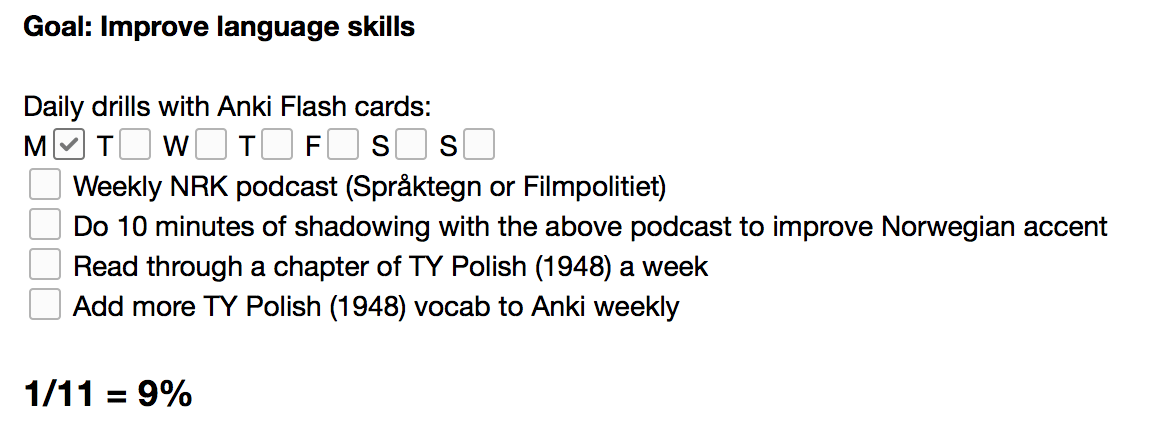
Now here’s the bit that really works for me: you score yourself weekly! Take all of those tactics, and you turn them into a weekly score. This can simply consist of crossing off list items on a paper plan each week. However, I like to use Evernote for making my lists, as you easily can add tick boxes to keep track. Here’s a sample weekly list from one of my plans:

Evernote tick list

Evernote tick list

At the end of the week, you tot up your score as a percentage, aiming to hit over 85%. This turns execution into a fun thing, a challenge to yourself. You’ll find yourself positively buzzing to tick boxes off early in the week in order to hit the threshold. Executing tasks for score-boosting ticks is surprisingly addictive!

It’s as simple as that. And it works!

The book is full of extra tips and tools for fine-tuning your plan, but the general idea is amazingly simple to implement and work into your life. It turns each day into a bit of a game for me, and I’ve cut my language procrastination right down.

Teachers could adapt these techniques for their students, too. Devise a weekly check-list of all the tasks they should be doing to improve steadily. There’s lots of scope there for adding competitive elements here, and comparing productivity rates at the end of every week. Who knows – they might find it so useful that they apply it elsewhere in their lives.

If you’re in a vocabulary rut, or find yourself falling behind and running out of time with your language goals, The 12 Week Year is worth a shot.

An ambulance attending an emergency; driver speaking in the window

Speaking tips from the emergency room

There’s no doubt about it: speaking can be hard, especially when you’re beginning in a foreign language.

You have all the usual mental juggling of remembering vocabulary and grammar. But on top of that, there’s the social pressure of performing live. In the heat of the moment, it’s too easy to panic and gibber. Neither of those will help you make yourself understood!

Now imagine that performance pressure, but in a matter of life or death. How would you, as a beginner in a foreign language, cope with making an emergency services call abroad?

This is exactly the kind of situation that research linguists Jennifer Gerwing and Jan Svennevig have aimed to unpick in their research. Much of their work has involved exploring real-life exchanges between native and second-language speakers in healthcare settings. But it is a piece of experimental research, recently presented at a conference exploring second language use, which really stirs the linguistic imagination.

Playing dummy

The experiment paired seventeen native English speakers with seventeen speakers of English as a foreign language. The first-language English speakers played the part of operators; their counterparts played callers. Those callers were to imagine that a friend (actually a resuscitation dummy!) had fallen unconscious. As a result, they would be making a call to emergency services. The operators were to instruct the callers in placing the dummy in the recovery position. The catch? They would be speaking entirely in English. What could possibly go wrong?

In fact, outcomes varied greatly, from great success to darkly comic dummy disaster. But the experimental scenario allowed the researchers to identify, compare and evaluate speakers’ strategies for making themselves understood. Specifically, Svennevig mentions three speaking strategies for helping to get your point across. The emergency call scenario may be specific, but all language learners can gain some insights from these three approaches.

simply speaking

Operators got their point across more clearly when they avoided complicated, technical or low-frequency vocabulary. They’re also the kind of words you’re less likely to know as a learner – the ones that frustrate you so much when you search for them and they’re simply not there. Don’t get frustrated – look for a simpler word instead.

Generalising what you mean to say can help: don’t know the word for ‘bungalow’? Say ‘small house’ instead. Forgotten the word for ‘fork’? What about ‘thing for eating’? Language hacker extraordinaire, Benny Lewis, takes this to the ultimate level with his ‘Tarzan speak’ method for making yourself understood as a beginner!

Break it down

We tend to speak in long, meandering sentences in our own language. We use connecting words, relative clauses, and all manner of other complex means to make our speaking fancy. This is counter-productive when ease of communication is the name of the game. Subsequently, operators found that breaking complicated instructions down into chunks helped callers no end.

You can harness the power of this as a learner, too. Resist that urge to try and translate word-for-word what is in your head. Instead, break it down! Don’t try to construct ‘I need the key to room 224 so I can go and fetch my bag’. It’s much easier to slow down and make that ‘I need the key. Number 224. My bag is in the room’.

Reformulate

This is the linguistic equivalent of covering your bases. If it doesn’t work the first time, say it in another way. Each time, you’re increasing the likelihood that you’ll be understood.

Saying things in a different way can add context and reduce misunderstandings. Why stop at “I’d like a glass of water?” Try “I’d like a glass of water. I’m thirsty. I need to drink”. That way, if you mispronounce or mangle one of those sentences, there are two others that the listener can use to grab your meaning. This is much better than the hopeless tourist technique of saying it once, then saying it louder!

Combo points

All three of these rules will aid communication on their own. In combination, though, the effects are cumulative. The magic of Svennelig and Gerwing’s experiment is that the researchers could actually measure these effects. For instance, operators using none of these strategies failed to get their instructions across at all. Those using just one had a 20% success rate. With two, comprehension levels reached 40% or so. But with all three, operators reached up to 60% efficiency in making themselves understood, despite quite basic language skills from the caller.

As a learner, you will find yourself in the role of caller, rather than the operator. But these three simple techniques still make a handy set of rules for not tying yourself in knots as a beginner speaker, whatever the scenario.

Statin’ the bleedin’ obvious?

Reading these three strategies, many will say that it’s just common sense. Isn’t it obvious that you’ll be better understood if you speak more simply? However, these techniques might not come as naturally as you think. After all, a whole experimental study showed that not everybody employs them automatically all the time.

As a language learner myself, I know how that performance pressure can overwhelm you. Situations take us over; we get swept away on a tide of speaking anxiety. Our beginner brains need some training in the subtle art of simplification.

So next time you feel at a loss for words, remember the emergency room – it may just save your (language) life.

This study was recently the subject of the excellent Norwegian radio programme Språkteigen, which deals with all things language-related. Thanks to Språkteigen for bringing the study, and the linguists behind it, onto my radar. The programme and podcast are highly recommended if you understand Norwegian!